
Management education in India continues to change. Workplaces expect clarity and responsibility at an early stage. Employers value ethical thinking and structured judgment. This shift explains why students and parents review the best MBA colleges in Ahmedabad before making a decision. Business education now shapes how you think and how you lead in real organisations.
Leadership no longer depends only on years of experience. Organisations observe behaviour and decision-making from the start. Management education plays a key role in this transition from learning to leadership.
Modern management education focuses on relevance. You study real business situations. You discuss cases and analyse outcomes. You participate in internships and live projects. These experiences improve judgement and communication.
Leadership grows when you explain ideas and listen to feedback. Classroom discussions test reasoning and clarity. Group activities develop patience and accountability. These settings reflect workplace realities.
The All India Survey on Higher Education for the year 2021-22, published by the Ministry of Education, Government of India, reveals that over 300,000 students apply for MBA and similar management courses every year. A limited number of institutions that meet strong academic and industry standards. This difference highlights the importance of choosing the right institution for leadership growth.
Ahmedabad offers access to many industries. Manufacturing and pharmaceuticals play a major role. FMCG and financial services also remain active. This environment supports applied learning. Many students shortlist the best MBA colleges in Ahmedabad due to this exposure.
The city also supports entrepreneurship. Family-managed enterprises operate alongside large corporations. This mix offers insight into different leadership styles. Students gain exposure to both structured systems and owner-driven decision-making.
Academic institutions benefit from strong corporate engagement. Industry leaders interact with students through lectures and projects. These interactions connect theory with practice and improve leadership readiness.
Leadership today requires balance. Business schools focus on knowledge and behaviour together. Education now supports professional maturity.
You develop leadership ability through:
Institutions that adopt outcome-based education equip their students with skills for a lifecycle of leadership that calls for consistency and reflection on a day-to-day basis. In conformity with this ideology comes the National Education Policy 2020, which has been published by the Ministry of Education, Government of India.
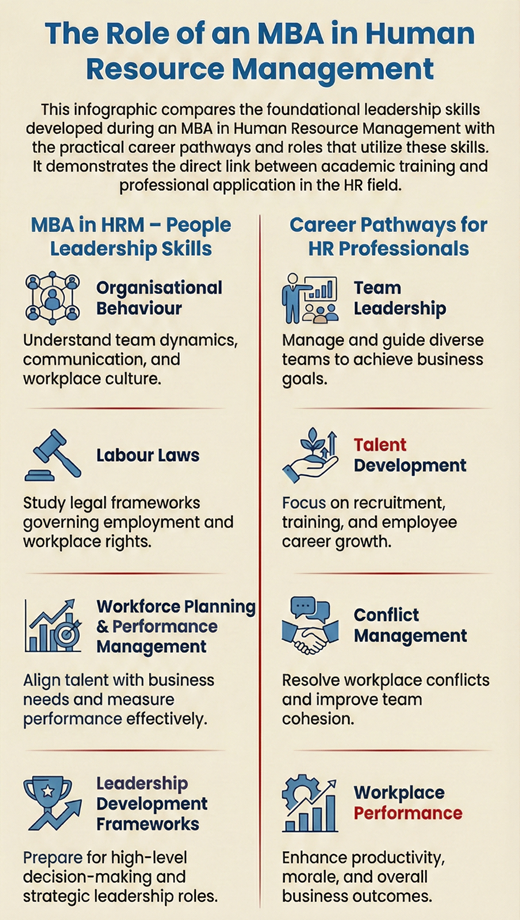
People leadership plays a central role in organisations. An MBA in human resource management prepares you to manage people, systems and workplace relationships.
You study organisational behaviour and labour laws. You learn workforce planning and performance management. You also engage with leadership development frameworks. These areas support decision-making across teams.
The India Human Capital Report 2023, released by the World Economic Forum in partnership with the Confederation of Indian Industry, has noted the increasing requirements for HR professionals with knowledge and skill competency in culture governance and leadership development. This trend reinforces the relevance of HR-focused management education.
Markets demand structured thinking. An MBA in marketing management develops leadership linked to insight and accountability.
You study brand strategy and consumer behaviour. You engage with digital platforms and analytics. You also learn sales planning and channel management. These subjects influence business growth decisions.
According to the “Digital Economy of India Report 2022,” published by the Ministry of Electronics and Information Technology, Government of India, there has been a “growing digital adoption in various sectors like retail, education, and healthcare.” Organisations value marketing leaders who combine data interpretation with strategic clarity.
Selection among the best MBA colleges in Ahmedabad depends on academic rigour and faculty strength. Institutions supported by a NAAC A+ accredited university reflect strong academic governance.
Faculty with doctoral qualifications from IITs, IIMs and leading global universities add depth to learning. Classroom discussions benefit from research-driven perspectives. This exposure improves confidence and clarity.
Leadership also depends on values. Business schools now integrate social awareness into education. You participate in rural immersion and community engagement activities. These experiences build empathy.
The UGC Guidelines on Community Engagement 2022, published by the University Grants Commission, emphasise social responsibility as a core outcome of higher education. Such exposure supports responsible leadership development.
Parents and educators often evaluate management education through outcomes. The Executive Education Market in India Report 2023, published by EY India, states that the corporate learning and executive education market is expected to reach USD 4 billion by 2027. This growth reflects sustained demand for leadership capability.
Graduates from strong institutions progress into roles across consulting, banking, FMCG, technology and entrepreneurship. Skills developed during an MBA continue to support judgment across career stages.
Leadership develops through discipline, exposure and values. Institutional choice shapes this journey. Colleges recognised among the best MBA colleges in Ahmedabad provide academic depth and industry connections.
Programs such as an MBA in human resource management and mba in marketing management prepare leaders who understand people and markets.